
Am I Parentifying My Own Child? How to Recognize It and Break the Cycle

Updated: Aug 11
By Dr. Maria Niitepold, PsyD | Licensed Psychologist | EMDR, Brainspotting & CRM
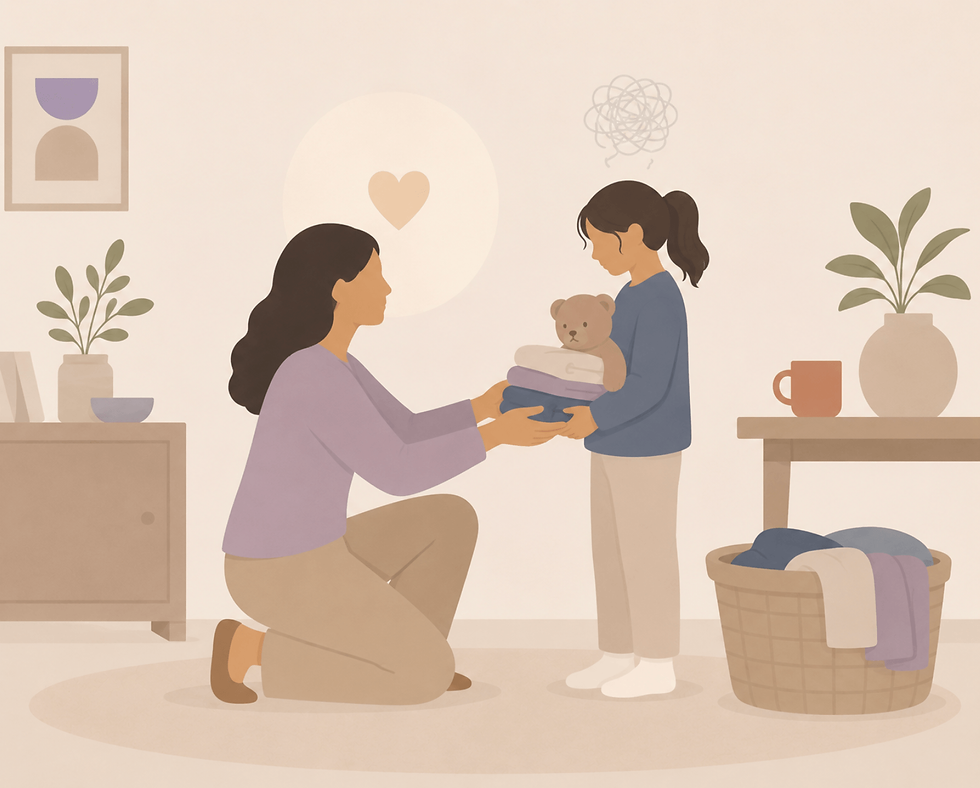
If you grew up as the responsible one, the child who managed the household's moods, mediated the arguments, and carried worries no child should have been handed, then there is a question that probably arrives at 2 a.m. now that you are the parent: am I doing it to them?
Let me say the most important thing first. The fact that you are asking is not proof that you are guilty. It is evidence of exactly the kind of awareness that unparentified parents rarely need to develop, and it is the single strongest predictor that the pattern stops with you. Parents who parentify without ever noticing do not lie awake interrogating themselves. You are lying awake because you know, in your body, what it cost you, and you would rather examine yourself honestly than hand the bill to your child.
So let us examine honestly. This post walks through what parentification actually is and is not, the specific ways it sneaks into loving homes, the signs to look for in your child and in yourself, and, most importantly, what breaking the cycle actually involves, which is both less and more than you think: less perfection, more repair, and one piece of work that is genuinely yours alone.
Quick Answer: Am I Parentifying My Child?
You may be parentifying your child if they regularly carry emotional or practical responsibilities beyond their years, comforting you, mediating adult conflict, or running the household. Healthy chores are different. The line is role reversal, when a child meets a parent's needs rather than the reverse. Noticing it is the first step to changing it.
Table of Contents
What Parentification Is (and What It Isn't)
Parentification is role reversal: a child regularly meeting a parent's emotional or practical needs, instead of the other way around. It comes in two broad forms. Instrumental parentification is the practical version, a child running the household, raising siblings, managing logistics that belong to adults. Emotional parentification is the quieter version, a child serving as a parent's confidante, comforter, mood manager, or mediator, and it is the form that most often hides inside otherwise loving homes.
What parentification is not: chores, responsibility, or contribution. A ten-year-old clearing the dinner table, feeding the dog, or learning to do her own laundry is not being parentified; she is being raised. Age-appropriate responsibility builds competence and belonging, and children genuinely benefit from mattering to the household.
The line is not whether a child helps. The line is direction: who is meeting whose needs. A child who helps with dinner is contributing to a family an adult is running. A child who monitors her mother's face to decide whether tonight is safe, who talks her father down, who keeps the peace between the adults, is running something no child should be assigned, whatever it looks like from outside.
The distinction matters because parentified parents often swing to the opposite pole, asking nothing of their children out of fear of repeating the past, and accidentally withholding the healthy responsibility children need. The goal is not a childhood without contribution. It is a childhood where the contribution never includes managing the adults.
Why the Pattern Repeats: The Inheritance You Didn't Choose
Here is the mechanism, stated without flinching and without blame: parentification repeats because it is what your nervous system knows about how children and parents work.
You learned parenting from the inside of your own childhood, decades before you ever held your own baby, and what you learned was not the content of the lectures. It was the structure of the roles. If the structure you absorbed was the child reads the parent, the child soothes the parent, the child carries what the parent cannot, then that structure lives in you as procedural knowledge, the same way your accent does.
Under stress, tired, overwhelmed, lonely, triggered, we all default to procedure. The pattern does not repeat because you are like your parents. It repeats because it is the only map anyone ever handed you, and unmapped territory is hard to navigate at 6 p.m. on a Tuesday with a crying child and an empty tank.
There is a second, sneakier driver: the skills themselves. You are, almost certainly, exceptionally good at being taken care of by no one. Your competence, your self-sufficiency, your radar for everyone's needs, these were forged in your parentified childhood, and they make you a formidable adult and a depleted one. A depleted parent with no adult support system and a highly attuned, eager-to-help child is the exact chemistry in which parentification quietly reassembles itself, one reasonable-seeming moment at a time.
Not because you are careless. Because the child in front of you is offering the very thing you were once praised for offering, and accepting it feels, for one dangerous second, like being loved the only way you ever were. How that early template quietly shapes the adult you became is the territory of how childhood emotional neglect creates emotional unavailability in adults, and the caretaker version of it, the compulsive responsibility that got you praised and emptied, is the pattern I take apart in eldest daughter syndrome.
Emotional Parentification: The Subtle Version in Loving Homes
Instrumental parentification tends to announce itself; emotional parentification whispers. It happens in warm, well-intentioned homes, between parents and children who adore each other, which is exactly what makes it hard to see. So here is what it actually looks like, in the versions I encounter most.
The child as confidante. You tell them about your stress, your loneliness, your conflict with their other parent, your money worries, not as age-appropriate honesty but as unloading, because they listen so well, because they get it, because there is no one else. The information itself is a weight, and the role, the one Mom can really talk to, is a heavier one.
The child as comforter. When you cry, they caretake. When you are anxious, they soothe. Occasionally being comforted by your child is human and even sweet; a pattern where your child is the one who regulates you is a role reversal, however tender it looks.
The child as mediator. They carry messages between adults, smooth the tension at dinner, intervene in arguments, or manage one parent's temper on behalf of the household. Diplomatic weight is adult weight.
And the subtlest: the child as emotional barometer-reader. They learn to read your face and adjust themselves accordingly, shrinking on the hard days, performing cheerfulness to lift you, editing their own needs when you seem full. Nothing is ever asked out loud. The assignment is ambient. This is where a child begins building the reflexive appeasement I describe in the fawn response and people-pleasing: the automatic yes, the vanished preferences, the safety-through-accommodation that will one day be mistaken for her personality.
If reading that list produced a wince of recognition, stay with me, because the next two sections are the ones that matter.
How It Leaks Through: The Everyday Doorways
Parentification in the second generation rarely arrives as a decision. It arrives through doorways, ordinary, understandable, exhausted moments, and knowing the doorways is most of the defense.
The venting doorway: a hard day, no partner or friend available, and a child who asks what's wrong, Mama? with those open eyes. The praise doorway: your child comforts you once, beautifully, and something in you lights up and calls it maturity, and the role begins to pay. The loneliness doorway: single parenting, deployment seasons, a distant marriage, and the child becomes the companion the adult is missing.
The conflict doorway: tension with your partner leaks sideways, and the child appoints herself translator and peacekeeper because someone has to be. The crisis doorway: illness, grief, a genuine emergency where everyone truly must carry more, which is survivable and even growth-producing, if the extra weight is named, bounded, and returned when the crisis ends. Crisis parentification becomes the chronic kind when the emergency arrangement quietly becomes the permanent one.
Notice what every doorway has in common: an unmet adult need, standing next to an attuned child. The pattern never starts with the child. It starts with the gap, which is why the deepest cycle-breaking work is not about parenting technique at all. It is about the gap.
If you grew up as the parentified child and now lie awake worrying you are doing the same thing to your own kids, the very fact that you are worried is part of what protects them, and it is also not something you have to untangle alone. I offer EMDR, Brainspotting, and CRM for exactly this inheritance, across New York and Florida and throughout all PsyPact states. You can request a free 15-minute consultation whenever you are ready.
Or call or text (850) 696-7218
This Is Not About Blame
Before the signs, a necessary word about the feeling this topic produces, because shame is the main reason parents cannot look at it squarely.
If you have recognized yourself in any of this, the shame spiral is probably already loading: I'm damaging my child, I'm becoming my mother, I knew I'd ruin this. Notice that voice, because it is not your ally here; it is the old verdict from your own childhood, repurposed. Shame collapses inward, and a parent collapsed inward cannot see her child clearly, which means the shame does not protect your child. It obstructs the seeing that would.
Here is the accurate frame. You were handed a pattern before you could refuse it. You are the first person in the line to stop, turn around, and look at it, which is not what failure looks like; it is what the end of a lineage of harm looks like, mid-process, unglamorous, awake at 2 a.m. Where shame makes you want to disappear, and I have written about why shame makes you want to disappear precisely because it hijacks moments like this one, responsibility does something different: it stays present, looks, adjusts, and repairs. Your child does not need a shameless parent or a perfect one. Your child needs a parent who can notice, own, and change course, and you are, at this exact moment, practicing all three.
Signs Your Child May Be Carrying Too Much
Look for patterns, not single moments. Every child comforts a parent occasionally; the signal is a role, running over time.
They ask about adult problems, money, the marriage, your stress, with a worried, managerial quality rather than passing curiosity
They monitor your mood and adjust themselves to it: quieter on your hard days, performing brightness to lift you
They comfort you more often than you comfort them, or seem uncomfortable, even guilty, when you take care of them
They mediate between adults: carrying messages, smoothing tension, intervening in conflict
They are described by everyone as "mature for their age," "an old soul," "so easy," and they rarely simply play
They have trouble asking for help, or apologize when they need things, as if their needs were an imposition
They hover near you when you are upset, unable to settle until you are settled
Their sibling-care has crossed from helping with the little ones into being responsible for them
They seem reluctant to add to your load: hiding struggles, minimizing bad days, editing their school troubles
And in yourself: you feel closer to this child than to any adult in your life, rely on them to feel okay, or feel a flash of resentment when they act their age
A few of these, occasionally, is family life. Several of them, as a stable pattern, is a child running a program she should never have been assigned, and the earlier it is noticed, the more completely it releases.
Healing Your Own Story: The Work That Is Actually Yours
Here is the sentence this whole post has been walking toward: the most powerful thing you can do for your child is to heal the parentified child you were. And if part of your fear is repeating this with your own children, I have written about how to know if you are parentifying your child, and how to stop.
Every doorway in the section above opens from the same side, the unmet need, the unprocessed past, the nervous system that still runs the old roles under stress. You can white-knuckle better behavior at every doorway, and you should guard them, but vigilance is a finite resource and stress always finds the doors vigilance forgot. What actually closes the doorways is resolving what stands behind them: the original parentification, still alive in your body as over-functioning, as the inability to have needs, as the reflex that reads every room and carries every weight.
That reflex was installed before you had words, which is why understanding it, and you likely understand it brilliantly by now, has not dissolved it. Insight cannot reach where it lives, a gap I explain in why understanding your trauma doesn't heal it.
In my practice, this work has a shape. We begin with resourcing, building, in your body, the felt experience of support and ground that your childhood never installed, because the parent who has an internal floor stops needing the child to be one. The Comprehensive Resource Model was built for exactly this kind of developmental gap, and if previous therapy ever felt like too much too fast, that has an explanation and a gentler path. From that ground, EMDR processes the original scenes, the nights you managed the household's weather, the moments your childhood was traded for competence, so they stop running your parenting from underneath.
And along the way we rebuild the middle of your nervous system's range, the regulated band where you can be with your child's big feelings without flooding or shutting down, the territory I map in the window of tolerance. The grief will come too, grief for the childhood you never had, and it deserves its own room; I have written separately about the grief of the parentified child, because mourning what you missed is part of not passing on the missing.
A regulated parent is a child who does not have to manage you. That is the whole equation, and it is why your healing is not selfish. It is structural.
Breaking the Cycle in Daily Life
Alongside the deeper work, the daily practice. None of this requires perfection; all of it bends the curve.
Build adult outlets for adult weight. Your stress, your marriage, your money, your loneliness go to adults: a partner, a friend, a therapist, a group. The test before sharing something heavy with your child: am I informing them, or unloading on them? Information at their level is honest parenting. Unloading is the doorway.
Let them be comforted more than they comfort. When they offer you care, receive it briefly and warmly, thank you, sweetheart, that helps, and return the roles: and it's my job to take care of you, not the other way around. You are not rejecting their love. You are teaching them it is not rent.
Give them chores, not roles. Responsibility for tasks builds children. Responsibility for people, for moods, for the family's okay-ness, burdens them. Keep the first generous and the second at zero.
Protect their frivolity. Play, silliness, boredom, age-appropriate irresponsibility, these are not the absence of maturity; they are the childhood. A child who is allowed to be young in front of you is a child who is not working.
And watch the praise. "You're so mature" and "you're my little helper," aimed at emotional caretaking, are the wages of the role. Praise their kindness, their effort, their ideas, and let the caretaking of you go conspicuously unrewarded.
Repair: The Skill That Changes Everything
You will get it wrong sometimes. You will vent when you shouldn't, lean when you're depleted, let a hard season blur the lines. Here is the finding that should let you exhale: the research on rupture and repair says children do not need parents who never miss. They need parents who repair, and repair is a skill your own parents almost certainly never modeled, which makes it the most cycle-breaking move in your repertoire.
Repair sounds like this, in age-appropriate language: "Hey, last night I talked to you about grown-up money stuff, and that wasn't yours to carry. That's my job and Dad's job, and we've got it handled. I'm sorry I put it on you." Short, warm, unburdened by your guilt, and without asking the child to reassure you about the apology, which would be the role sneaking back in through the repair itself.
What repair does is quietly revolutionary. It corrects the record, this weight was never yours. It models accountability without collapse, adults can be wrong and stay steady. And it teaches the deepest lesson a parentified lineage can learn: that love in this family does not run on a child's labor. Every repair is a small proof that the roles have changed hands, and the proofs accumulate. The cycle does not break in one dramatic vow. It breaks here, in the ordinary Tuesday apology, delivered by a parent who was never given one.
Frequently Asked Questions
What's the difference between chores and parentification?
Direction and weight. Chores are age-appropriate tasks a child contributes to a household an adult is running: dishes, laundry, feeding the pet, watching a sibling for twenty minutes while you shower. Parentification is role reversal: the child carrying responsibility for the parent's emotional state, for adult problems, or for the household's functioning itself. A useful test is what happens if the child doesn't do it: if the answer is a normal consequence and an adult picks up the slack, it was a chore; if the answer is that something essential to the family's emotional or practical survival goes unheld, the child was holding a role. Contribution builds children. Roles burden them.
Is it wrong to ever cry in front of my child or tell them I'm sad?
No, and the opposite extreme, performing invincibility, teaches its own unfortunate lesson: that feelings must be hidden. Children benefit from seeing parents have emotions, name them, and handle them: "I'm feeling sad today, and I'm okay, and it's not your job to fix it" is healthy modeling. The line is who does the emotional labor afterward. If you have the feeling and you (with other adults) regulate it, your child learns feelings are survivable. If your child becomes the one who must comfort, cheer, or monitor you, the moment has crossed from modeling into role reversal. Honest, bounded, already-being-handled: that is the formula.
My child seems to want to take care of me. Isn't refusing that rejecting their love?
Receive the love; return the role. When your child comforts you, take it in warmly and briefly, that hug helped, thank you, and then re-establish the structure: and taking care of you is my job. What you are declining is not their love; it is the contract in which their love must be paid as labor. A child whose caretaking is politely, consistently not needed learns something priceless: that they are loved for existing, not for functioning. Watch, too, for the pull inside yourself when they caretake beautifully, the warmth of finally being tended. That pull is your own parentified child, recognizing the only currency she was ever paid in, and it is a signal for your healing work, not for accepting the payment.
I'm a single parent and my kids genuinely have to help more. Am I parentifying them?
Not necessarily, and this distinction deserves care rather than guilt. Higher practical contribution in a single-parent home, more chores, more sibling-minding, more teamwork, can be healthy interdependence when it is bounded, named, and age-calibrated. The risks to guard are specific: the child becoming your emotional partner, confidante for adult loneliness or co-parent conflict; practical responsibility crossing from tasks into being in charge of the household; and the helping becoming their identity rather than their contribution. Protect adult outlets for your adult needs, keep their access to play and friendships intact, and periodically say out loud that the adult jobs are yours. Necessity plus boundaries is resilience. Necessity without them is where the role begins.
I think I've already parentified my child. Is the damage permanent?
No. Children are remarkably responsive to genuine change in the family system, and the pattern you are worried about is one you can begin revising today: role reversal that is noticed, named, repaired, and consistently changed tends to release, especially when it is caught while they are still at home. What calcifies parentification into adult wounds is decades of it, unacknowledged. Your repair conversations, your redistribution of the weight, and, most powerfully, your own visible healing all rewrite the lesson in real time. Many adults I work with say the parentification itself hurt less than the fact that no one ever saw it or said sorry. You are already doing both.
Should I apologize to my child for the past, and what do I say?
Yes, when it is done for them rather than for your absolution, and the distinction shapes the delivery. Keep it short, specific, and unburdened: "I've realized I've leaned on you with grown-up stuff, like [specific example]. That was never yours to carry, it's my job, and I'm handling it differently now. I'm sorry." Then stop. Do not catalog your guilt, explain your childhood at length, or linger in a way that requires them to comfort you about the apology, which would re-run the role inside the repair. Expect an anticlimax; children often shrug, and the shrug is fine. The message lands over time, confirmed not by the conversation but by the changed pattern that follows it.
Do I need therapy to break the cycle, or can I do this on my own?
You can do real, meaningful work on your own: guarding the doorways, redistributing weight, repairing, protecting their childhood. What is genuinely hard to do alone is the layer underneath, the original parentification still running in your nervous system as over-functioning, needlessness, and the reflex to carry everything, because that layer was installed before words and does not respond to insight or resolve. That is where somatic trauma therapy earns its place: resourcing to build the internal floor you never got, EMDR and Brainspotting to process the childhood that installed the role, so the doorways stop pulling. My childhood emotional neglect therapy works with exactly this inheritance. The daily practices protect your child now. The deeper work is what makes the protection effortless.
The Cycle Can Stop With You
It is worth saying plainly: this is not about taking on one more self-improvement project, one more way to over-function, this time at healing. It is about finally receiving the care you have been dispensing your whole life, and letting that repair flow downhill to your child on its own. Most parentified parents find that the work feels less like another job and more like the first time someone carried something for them. That tends to feel like relief, not another item on the list.
You are not a bad parent for carrying a pattern you were handed. You are a parent paying close enough attention to stop handing it down, and the child you are protecting includes, if you let this work reach all the way back, the one you used to be.
I work with parentified adults, many of them parents asking exactly your 2 a.m. question, in person at my Gulf Breeze, Florida office and online across New York, Florida, and all PsyPact states, using CRM, EMDR, and Brainspotting. You can see the areas I serve or request a free 15-minute consultation.
Or call or text (850) 696-7218
That attention you are paying is exactly what breaks the cycle.
Explore More
Dr. Maria Niitepold, PsyD
EMDRIA-Trained Trauma & Somatic Therapist
Serving High-Achievers Across New York and Florida
(850) 696-7218. Call or text anytime.
Healing doesn't have to be hard. It just has to start.
(Disclaimer: This blog post is for educational purposes and does not constitute medical advice or a formal doctor-patient relationship. If you are experiencing a mental health crisis, please contact your local emergency services or call 988.)


Comments