
We Don't Talk About That: Mental Health Stigma in Immigrant Families
- Maria Niitepold
- 3 days ago
- 13 min read

By Dr. Maria Niitepold, PsyD | Licensed Psychologist | EMDR, Brainspotting & CRM
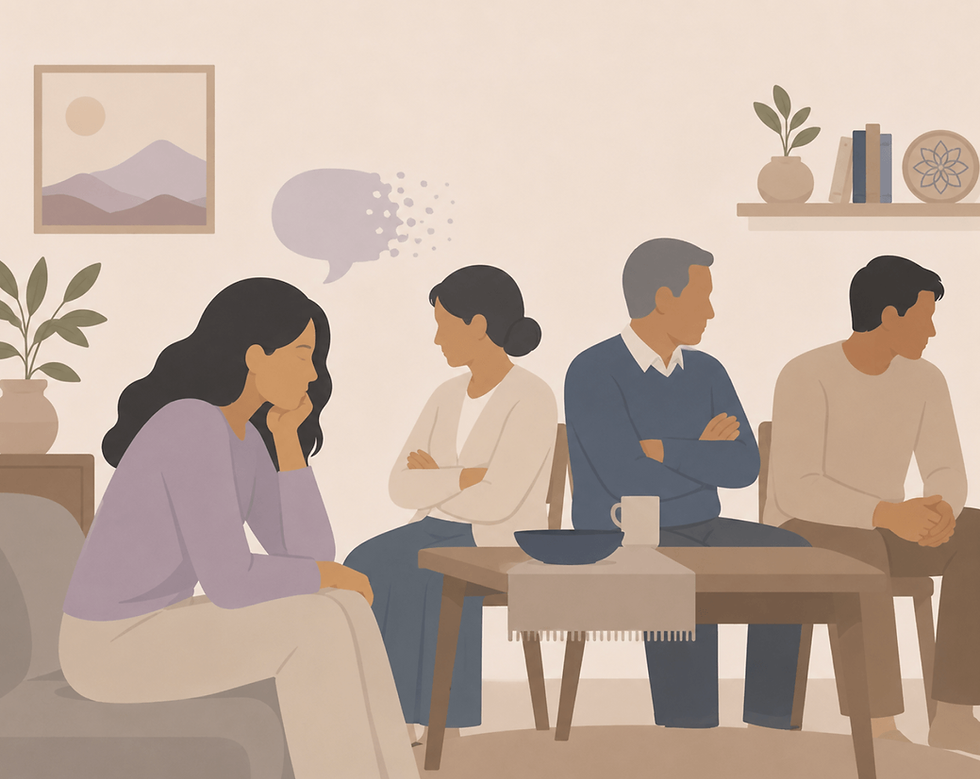
There is a phrase that runs through so many immigrant households, spoken or unspoken: we don't talk about that. We don't talk about the depression, the anxiety, the thing that happened, the relative who struggled and was quietly never mentioned again. You keep your head down, you work, you achieve, and you do not air the family's pain to anyone, least of all a stranger you pay to listen.
As an immigrant myself, and as a therapist who works with many adults from immigrant families, I know that silence from the inside, and I know how heavily the mental health stigma in immigrant families can sit, and how much guilt surrounds even the thought of breaking it.
I want to be clear from the start that this silence is rarely cruelty. It is almost always a survival adaptation, often inherited from parents who carried more than they were ever able to put down. Understanding where it comes from is the first step to setting your share of it down without betraying the people who handed it to you.
Quick Answer: Why Is Mental Health So Stigmatized in Immigrant Families?
In many immigrant families, mental health is stigmatized because survival left no room for feelings, because struggling can feel like betraying a parent's sacrifice, and because "what will people think" carries real communal weight. The silence is a survival adaptation, not cruelty, and you can seek help without dishonoring your family or rejecting your culture.
Table of Contents
"We Don't Talk About That": What the Silence Sounds Like
The stigma rarely arrives as a single rule. It arrives as a thousand small messages, absorbed so early that they feel like simple facts about the world rather than beliefs you could ever question.
It sounds like what will people think. It sounds like we do not air our dirty laundry. It sounds like just pray about it, or you have a roof over your head, what do you have to be sad about, or therapy is for crazy people, or that is a luxury for people who have nothing real to worry about. Sometimes it is more pointed: therapy is a Western thing, a white thing, not for us. And sometimes the message is not spoken at all. It is simply the complete absence of any language for inner life, a household where feelings were never named, never asked about, and certainly never tended to.
Whatever form it took, the lesson landed in the same place. You learned that pain is private, that struggling is shameful, and that the family's reputation depends on everyone appearing fine. The shame that grows in that kind of silence has a particular quality, the kind that makes you want to disappear rather than be seen needing anything, which I describe in why shame makes you want to disappear.
Where the Stigma Actually Comes From
If you are going to set this silence down without resentment swallowing you whole, it helps enormously to understand that it did not come from nowhere, and it did not come from your family not caring.
For many immigrant parents and grandparents, survival was the entire project. When you are working three jobs, navigating a new language, sending money home, and trying to keep children fed and safe in an unfamiliar country, there is genuinely no bandwidth for processing feelings. Emotional attunement is a capacity that requires safety and spare resources, and many immigrant families had neither. A great deal of what looks like coldness is really exhaustion and triage, the same dynamic by which emotional neglect can pass down through families that simply had nothing left to give.
There is also, very often, unprocessed trauma in the generation that came before. War, displacement, poverty, persecution, the losses of leaving a homeland. Parents who survived those things frequently coped by not looking back, by sealing the past away and pushing forward, and a family system built on not looking back cannot easily make room for a child who wants to look inward.
On top of this sit real cultural factors that deserve respect rather than dismissal: collectivist values where the family's standing in the community genuinely matters, religious or spiritual frameworks that locate suffering and its remedy elsewhere, and an often well-earned distrust of institutions and authorities, sometimes rooted in real mistreatment back home. None of this is backwardness. It is a coherent response to hard circumstances. It simply was not built to hold what you are carrying now.
The Sacrifice Narrative as a Silencer
There is one particular form the stigma takes that deserves its own attention, because it is the one that silences people most effectively: the sacrifice.
We gave up everything for you. We left our home, our families, our language, our careers, so that you could have a better life. For most immigrant children, this is not a manipulation. It is simply true, and the gratitude it produces is real and deep. But the sacrifice narrative has a shadow side. When everything was given up for your better life, your unhappiness can feel like an indictment of that sacrifice, proof that it was not enough or was not worth it. So you learn to hide the struggle, not because anyone forbade it outright, but because naming it feels like ingratitude, like spitting on the gift.
This is the trap. The sacrifice that was meant to give you a good life becomes the reason you cannot admit when your life is hard. You end up protecting your parents from your pain, managing their feelings about your wellbeing instead of tending to your wellbeing itself. The result is a very specific kind of suffering: real, hidden, and wrapped in guilt for even existing.
The Second Generation, Caught in Between
If you are the child of immigrants, you likely live with a particular and disorienting split. You were raised inside the stigma, but you are living in a culture where therapy is increasingly normal, where your friends casually mention their sessions, where the language of mental health is everywhere. You can see help on the table. You may even believe in it. And you still feel that you are not allowed to reach for it. That split, belonging everywhere and nowhere at once, runs through far more of second-generation life than the therapy question alone.
Many second-generation adults also carried adult-sized roles far too young. You may have been the family's translator, the one explaining bills and medical forms and immigration paperwork at nine years old, the cultural broker between your parents and a country they were still learning. That role is a genuine form of parentification, and the grief and over-responsibility it leaves behind is something I explore in the hidden grief of the parentified child. You learned to be the capable one, the one who handles things, the one who does not add to the load, which makes asking for help as an adult feel not just frightening but almost structurally impossible.
If you grew up in a family where you don't talk about that, where struggling felt like betraying everything your parents sacrificed for, you are allowed to need help, and needing it does not make you weak or ungrateful. I offer EMDR, Brainspotting, and CRM for adults from immigrant families carrying pain they were never allowed to name, across New York and Florida and throughout all PsyPact states. You can request a free 15-minute consultation and simply see how it feels to say the unsaid thing out loud to someone who will not flinch.
Or call or text (850) 696-7218
What the Silence Quietly Costs
The stigma is not free. It has a price, and the price is paid in the body and in the quality of a life.
When pain has nowhere to go, it does not disappear. It goes underground and comes out sideways, as the chronic tension and gut problems and exhaustion that doctors cannot fully explain, because the nervous system keeps a record even when the mouth stays shut. This is why, for so many people from these families, talking alone never quite resolves it, and why the body has to be part of the healing, as I describe in why somatic therapy reaches what just talking cannot.
The silence also tends to produce a profound, practiced self-reliance, a sense that you must handle everything alone because asking is not an option, which is its own quiet trauma response and its own kind of exhaustion, explored in why hyper-independence is not the strength it looks like.
And then there is the deepest cost. Untended, the silence passes down. The parent who could never name their own pain raises a child who learns the same lesson, and the inheritance continues, generation after generation, until someone finally decides to set it down. That someone is often the person reading an article like this one.
"Isn't Going to Therapy a Betrayal of My Family?"
This is the question underneath all the others, and it deserves a real answer rather than a slogan.
The fear is that seeking help means airing the family's secrets, judging your parents, choosing a foreign value over your own people, or declaring that the life they built for you was not good enough. I want to gently take each of those apart. Therapy does not require you to blame your parents or reject your culture. Good therapy holds the whole truth at once: that your parents may have loved you fiercely and done real harm, that your culture is a source of both wounding and deep belonging, that gratitude and grief can live in the same chest. You are not asked to choose a side.
And there is a reframe worth sitting with. The entire point of the sacrifice, the reason your family left everything, was so that you could have a fuller life. Tending to your mental health is not a betrayal of that sacrifice. It may be the truest fulfillment of it. Living well, healing what hurts, and breaking the silence so it stops passing down is exactly the better life they were reaching for, even if they would not have used these words for it. You can love your family completely and still get help. The two were never actually in conflict.
If contact with family tends to leave you worse rather than better, that pattern itself is worth understanding, which I write about in why you can feel worse after talking to your parents.
What Culturally Humble Therapy Actually Looks Like
I want to be honest about my own position here. I am an immigrant, but I came from Estonia, and I do not pretend to share or fully understand the specific cultural context of every person who sits with me. What I bring is not expertise in your culture. It is genuine curiosity about it, respect for it, and a refusal to ask you to leave it at the door. The work I do with adults from immigrant families is the heart of my therapy for those navigating cross-cultural identity, and it begins from cultural humility rather than assumption.
In practice, that means we do not treat your family as a villain or your culture as a problem to be solved. We make room for the love and the harm together. It means your faith, if you have one, is welcome in the room, not something therapy competes with. And because so much of what immigrant families carry was never put into words, and was often felt long before language, I work primarily with body-based methods rather than talk alone. EMDR, Brainspotting, and the Comprehensive Resource Model let us process what is held beneath words, gently and at a pace your nervous system can tolerate. For people who have understandably guarded this material their whole lives, that careful, well-resourced pacing matters enormously, which is exactly what the gentler approach of CRM is designed to provide.
None of this happens faster than you allow. You will never be pushed to expose your family, to condemn anyone, or to hand over your history before you are ready. We can begin with a single thread, one feeling, one memory, one symptom you are tired of carrying, and let the rest stay yours until you decide otherwise. For someone raised to guard the family's privacy as a matter of loyalty, that control over the pace is not a small detail. It is very often the thing that makes the work feel possible at all.
Checklist: Is the Silence Costing You?
Read slowly, and notice the body's response as much as the mind's. If several of these land, the silence may be costing you more than you have let yourself admit.
You grew up believing that struggling was shameful, private, or something the family did not discuss.
You feel guilty even considering therapy, as though it would dishonor your parents' sacrifice.
You are the capable one who handles everything and rarely, if ever, asks for help.
You carry physical symptoms, tension, fatigue, gut trouble, that doctors cannot fully explain.
You manage your parents' feelings about your wellbeing instead of tending to your wellbeing itself.
You believe in therapy for other people but feel it is somehow not allowed for you.
You sense that the silence is something you inherited, and you do not want to pass it on.
Frequently Asked Questions
Is mental health stigma really worse in immigrant families?
It is often more intense, though it varies enormously across cultures, generations, and individual families, so no single description fits everyone. What tends to make it stronger in immigrant contexts is the combination of survival-mode parenting that left no room for emotional life, unprocessed trauma in earlier generations, collectivist concern for the family's standing, and the weighty sacrifice narrative. These factors stack in ways that can make acknowledging struggle feel not just uncomfortable but actively disloyal. None of this means your family was bad. It means the conditions made silence feel necessary.
Do I have to tell my parents I am going to therapy?
No. You are an adult, and your mental health care is yours to decide on and yours to keep private if that is what feels safe. Some people eventually choose to tell their families and find it opens something. Others keep it private, sometimes for years, sometimes permanently, and that is a legitimate choice rather than a cowardly one. The goal is to get you the care you need, not to force a disclosure your family may not be ready for. We can work with whatever your real situation allows.
Isn't therapy a Western or white concept that doesn't fit my background?
The formats can carry a Western imprint, and that critique is worth taking seriously. But the underlying human realities, that pain needs witnessing, that the nervous system can heal, that we are not meant to carry everything alone, are not the property of any one culture. Many cultures have their own deep traditions of healing, community, and restoration. Good therapy does not ask you to abandon yours. It works alongside it, and a culturally humble therapist will be curious about your traditions rather than dismissive of them.
I feel guilty getting help when my parents sacrificed so much. Is that wrong?
The guilt is completely understandable, and it is not a sign you are doing something wrong. It is the sacrifice narrative doing exactly what it does. Here is the reframe I offer: the purpose of your parents' sacrifice was a better life for you, and tending to your mental health is part of building that better life, not a rejection of it. Healing what hurts and refusing to pass the pain down may be the deepest honoring of their sacrifice available to you, even if they would never have framed it that way themselves.
My parents say I have nothing to be sad about. Am I wrong to struggle?
No. Having a roof, food, and opportunities your parents did not have does not make your pain invalid. Comparative suffering is not how mental health works; depression and anxiety do not check your circumstances first. Your parents likely say this not to be cruel but because, for them, those material things were the dividing line between safety and danger, so having them feels like having everything. You can hold deep gratitude for what you have and still struggle, and still deserve help. Both are true at once.
Can therapy actually respect my culture and my religion?
Yes, and it should. Your culture and your faith are not obstacles to therapy. They are part of who you are and often part of what sustains you, and a good therapist treats them as resources rather than problems. Faith and therapy are not in competition; many people find that the two complement each other. The work I do begins from genuine respect for your background, with curiosity about it rather than assumptions, and never asks you to choose between healing and your roots.
Can you help if my family would not approve, or if I need to do this privately?
Yes. Many of my clients are doing this work without their families' knowledge or approval, and I hold that reality without judgment. Your care does not require anyone else's permission. Sessions are confidential, telehealth makes privacy easier, and we can go at whatever pace your circumstances require. The fact that you would have to do this quietly is itself a piece of what we are working with, and it does not have to stop you from getting the support you deserve.
You Are Allowed to Set It Down
The silence you grew up in protected the people who handed it to you. It was a survival tool in conditions that demanded survival above all else. But you are living in different conditions now, and what kept your family afloat may be quietly drowning you. You are not weak for needing help, and you are not ungrateful for wanting to feel better. You are not betraying your family by tending to the pain they could not tend to. You are doing the very thing the whole sacrifice was for.
I work with adults across New York and Florida, and from my office in Gulf Breeze, who grew up in families where they do not talk about that and who are quietly ready to. My cross-cultural, identity-aware therapy is built to hold your whole story, the love and the harm, the gratitude and the grief, without asking you to choose between healing and your roots. You can see the areas I serve or request a free 15-minute consultation, and we can begin gently, privately, and at your pace. I also work with clients in person at my Gulf Breeze, Florida office.
Or call or text (850) 696-7218
Explore More
Why Do I Automatically Agree to Things I Desperately Want to Say No To? (The Fawn Response)
Do You Have to Tell Your Trauma Story to Heal? Why the Answer Is No
Eldest Daughter Syndrome: The Psychology of the Compulsive Caregiver (Type A3)
The Fear of Being Seen: When Visibility Feels Unsafe (and How to Gently Unlearn It)
Dr. Maria Niitepold, PsyD
EMDRIA-Trained Trauma & Somatic Therapist
Serving High-Achievers Across New York and Florida
(850) 696-7218. Call or text anytime.
Healing doesn't have to be hard. It just has to start.
(Disclaimer: This blog post is for educational purposes and does not constitute medical advice or a formal doctor-patient relationship. If you are experiencing a mental health crisis, please contact your local emergency services or call 988.)


Comments