
Therapy for Immigrants and Their Children: The Hidden Grief and Trauma No One Names
- Maria Niitepold
- Aug 10
- 13 min read

By Dr. Maria Niitepold, PsyD | Licensed Psychologist | EMDR, Brainspotting & CRM

When people search for therapy for immigrants, they are often not looking for help with the obvious, dramatic version of trauma. They are successful. They built the life. They learned the language, got the degree, raised the children, sent money home. And underneath all of it sits something they have rarely had words for and almost never had permission to feel: a grief for everything that was left behind, and a quiet, persistent sense of never fully belonging anywhere.
I understand this from the inside. I am an immigrant myself, having come to the United States from Estonia, and I have spent a long time learning, both personally and clinically, that migration leaves a mark that gratitude and achievement do not erase. If you have spent years being the strong one, the grateful one, the one who made it, and you cannot understand why you still feel unsettled, this is for you. What you are carrying is real, it has a name, and it can be tended to.
Quick Answer: Why Do Immigrants Carry Unspoken Grief and Trauma?
Migration is rarely a single event. It is a layered loss of home, language, status, and belonging, often without any permission to grieve it. Many immigrants stay in survival mode for years, and the unprocessed grief and trauma settle into the body, surfacing later as anxiety, numbness, or exhaustion long after the move is over.
Table of Contents
Migration Is Not One Event, It's a Layered Loss
The first thing I want to name is that leaving one country to build a life in another is not a single moment you can point to and move past. It is a cascade of losses, many of them invisible and most of them never formally mourned.
You lose a homeland, a landscape, a way the light fell. You lose a language in which you were fluent, funny, fully yourself, and trade it for one in which you are always translating, always a beat behind, often underestimated. You lose proximity to parents and siblings and friends, and you lose the small daily belonging of being among people who simply understand you without explanation. Many immigrants also lose status, arriving as a doctor or an engineer and starting over in a job far below their training. And you lose a version of the future you had once imagined for yourself.
Psychologists call some of this ambiguous loss, a grief without closure. The homeland still exists, but you cannot return to the one you left, because it has changed and so have you. The people are still alive, but separated by oceans and time zones and the slow drift of years. There is no funeral for this kind of loss, no ritual, no casserole brought to the door. So it goes ungrieved, and ungrieved loss does not disappear. It goes underground and waits.
The Trauma That Comes Before, During, and After
It also helps to separate the different layers of difficulty, because they call for different things.
Some immigrants carry pre-migration trauma, the war, persecution, poverty, or violence that drove them to leave in the first place. Some carry trauma from the migration itself, dangerous journeys, detention, family separation, years of uncertainty about whether they could stay. And almost all carry post-migration stress, the ongoing grind of discrimination, financial precarity, language barriers, isolation, and the exhausting work of rebuilding an entire life from nothing in an unfamiliar place.
These layers stack. A person can be safe now, materially stable, even thriving on paper, and still have a nervous system that never got the message that the danger is over. The body learned, often over years, that vigilance was survival, that you could not relax, that you had to work twice as hard to be seen as half as legitimate. That learning does not switch off just because the circumstances improved. This is why so many immigrants live with a baseline of anxiety or a strange flatness they cannot explain. The threat passed, but the system that adapted to it is still running.
Why "Be Grateful" Keeps the Wound Sealed
Here is one of the cruelest mechanisms I see, and it is almost universal among the immigrants I work with. The story you were given, and the story you tell yourself, is that you should be grateful. You made it. You have opportunities your parents could only dream of. Other people had it so much worse. Who are you to complain?
Gratitude is real, and it is not the problem. The problem is what gratitude gets used to do. It becomes a lid. Every time grief or anger or loneliness rises, the gratitude narrative slams it back down. You are not allowed to mourn what you lost, because mourning feels like an insult to the sacrifice that got you here. So the feelings never get to move. They just get sealed, and a sealed wound is exactly the kind that festers.
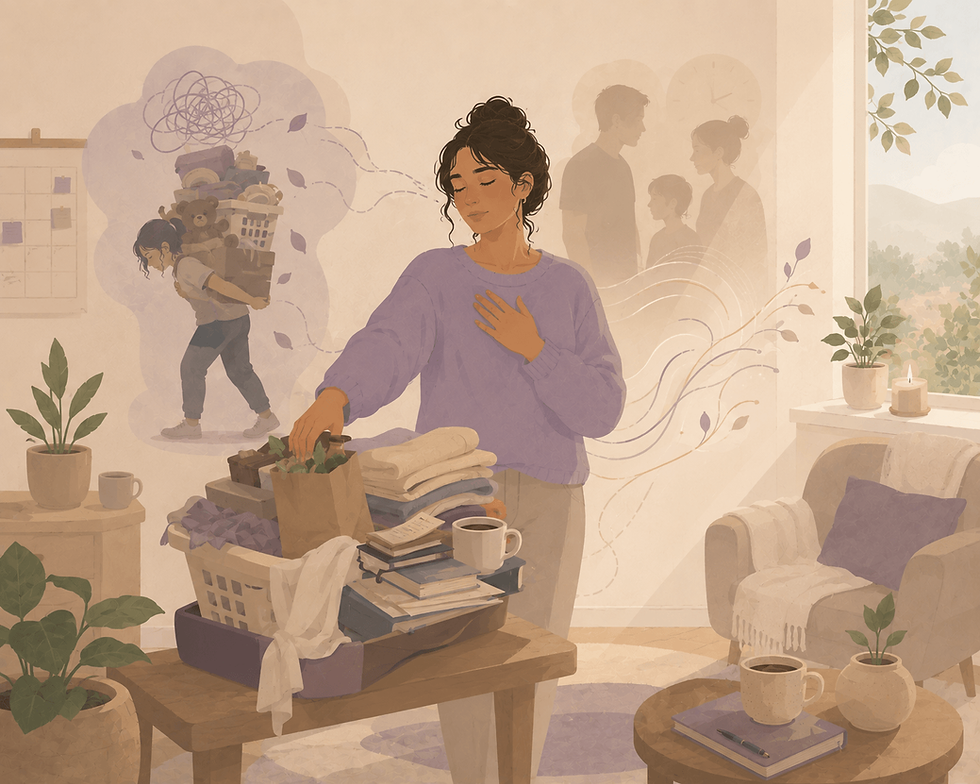
This is reinforced by survival mode itself. When you are working three jobs and learning a language and keeping a family afloat, there is genuinely no time or safety to fall apart. Grieving is a luxury that requires stability you did not have. So you postponed it, sensibly, for years. The trouble is that the feelings did not understand they were being postponed. They simply waited, and now, often when life finally calms down, they arrive all at once and you cannot understand why you feel worse now that things are objectively better.
The Exhaustion of Living Between Two Worlds
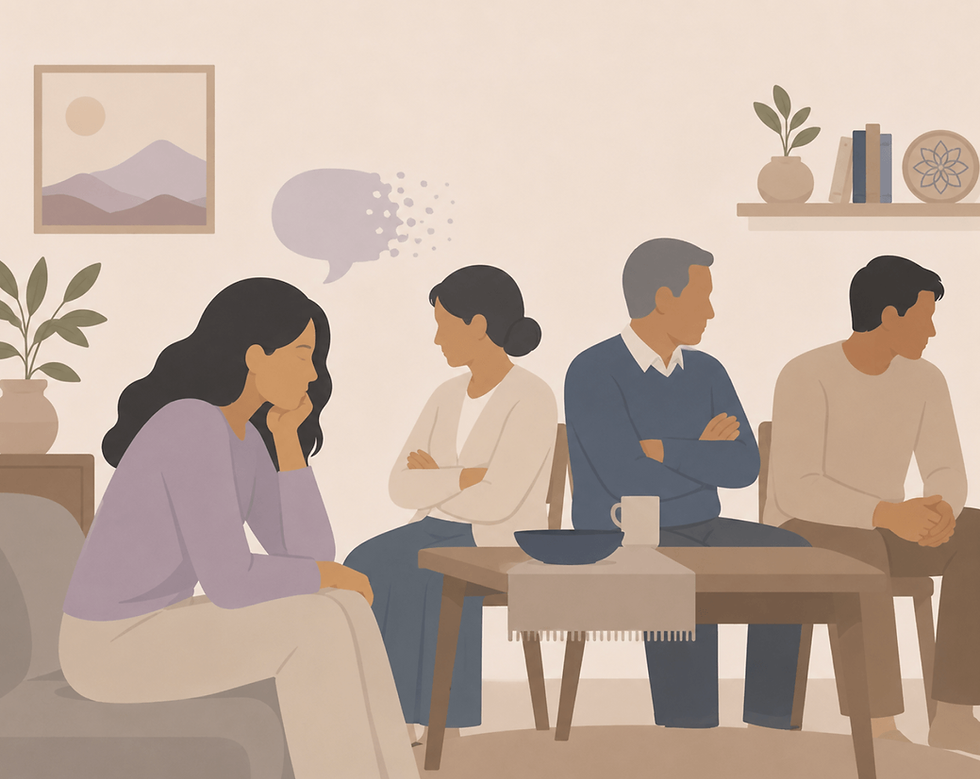
There is a particular tiredness that comes from belonging to two cultures and feeling fully at home in neither. Psychologists call the ongoing strain of this acculturative stress, and it is its own slow form of depletion.
You code-switch constantly, shifting language, manner, humor, and even posture depending on the room. You are one person at work and another at home, one person with your children and another with your parents. To the culture you came from, you may have become too foreign. To the culture you live in, you remain not quite from here. This is the homelessness of the in-between, and it is exhausting in a way that is hard to explain to anyone who has never lived it. And if your childhood involved not two fixed worlds but a rotating series of them, a new country every few years, that pattern has its own distinct territory, which I map in adult third culture kids and belonging everywhere and nowhere.
Many immigrants respond to the in-between by becoming relentlessly self-reliant, never asking for help, carrying everything alone, which is its own trauma response. I write about that pattern in why hyper-independence is not a strength but a survival adaptation, and it is especially common in people who learned that no one was coming to help them in a new country.
For high-achieving immigrants this often hardens into a particular shape. You over-function, you out-work everyone, you treat exhaustion as the price of belonging, and you burn out without ever feeling you have done enough. That is the engine I describe in high-functioning anxiety and why high-achievers burn out, and for immigrants it carries an extra weight, because the achievement is also meant to justify the entire family's sacrifice.
If you have spent years being strong, being grateful, and building a life in a new country while quietly carrying a grief you have never had permission to feel, that grief is real and it deserves care. I offer EMDR, Brainspotting, and CRM for immigrants and the children of immigrants, across New York and Florida and throughout all PsyPact states. If any of this resonates, you can request a free 15-minute consultation and we can talk about what it would mean to finally set some of this down.
Or call or text (850) 696-7218
The Specific Burden of the First-Generation Child
The children of immigrants carry a distinct version of all this, and it deserves its own attention, because they often do not recognize that what they feel is trauma-related at all.
If you grew up as the first-generation child, you may have been the family's translator from a young age, fielding adult conversations with landlords, doctors, and government offices long before you were ready. You may have absorbed your parents' stress and stepped into a caretaking role, becoming the parent to your own parents in a strange country. That role-reversal has a name and a real cost, which I unpack in the grief of the parentified child. You likely felt the pressure to succeed not just for yourself but to make the sacrifice worth it, to be the return on an enormous investment.
And you grew up split. At home, one language, one set of expectations, one emotional climate. Outside, another entirely. Many first-generation children describe never feeling fully accepted in either world, and quietly editing themselves to survive both. On top of that, immigrant parents are frequently in too much survival stress to attune to a child's inner emotional world, not from lack of love but from sheer depletion. The result can look a great deal like childhood emotional neglect, where your material needs were met devotedly while your emotional ones went unseen. If you have always felt vaguely guilty for needing anything at all, this is often where it began.
When the Trauma Was Passed Down
Trauma does not always stay in the person who lived it. What a parent cannot process, a child often inherits, not through stories but through nervous systems, through a parent's reactivity, silences, fears, and the unspoken rules of the home.
This is what clinicians mean by intergenerational trauma. The grandmother who survived war and never spoke of it. The father whose vigilance filled the house without anyone naming why. The mother whose grief for her own lost homeland leaked into every interaction. Children raised in these homes absorb the emotional residue of events they never directly experienced, and they can spend a lifetime carrying a fear or a sorrow that does not feel like it belongs to them, because in a sense it does not. It was handed down. Naming this is not about blaming the previous generation, who were usually doing their best under impossible conditions. It is about recognizing that the wound is real even when the original event was not yours.
Why Body-Based Therapy Reaches What Words Cannot
Here is where the way I work matters enormously for immigrants specifically. So much of this experience is either preverbal, stored in the body before there were words for it, or trapped in a language that is not the one you now live in. Traditional talk therapy asks you to narrate your pain, often in your second or third language, which can leave the deepest material untouched because it was never encoded in English in the first place.
The approaches I use, EMDR, Brainspotting, and the Comprehensive Resource Model, work below language. They reach the experience where it is actually stored, in the body and the deeper brain systems, without requiring you to find the right words in a borrowed tongue. This is why I find them so well-suited to immigration trauma. You do not have to translate your grief to process it. I describe the broader reason talking is not enough in why somatic therapy works where talk therapy stalls, and the principle is doubly true when the wound lives in a language you no longer speak every day.
How I Work With Immigrant Clients
I want to be honest about what I do and do not offer. I cannot claim to understand every culture, and I would be wary of any therapist who did. What I bring is a felt understanding of displacement itself, the specific disorientation of building a self in a country that was not your first, and a way of working that does not require you to explain your entire world before we can begin.
We usually start by building stability and internal resources rather than going straight at the painful material, especially if your nervous system has been in survival mode for a long time. I explain why that foundation matters in why your body has to feel safe before trauma processing can work. For clients who have found other trauma work too overwhelming, or who carry a great deal beneath the surface, the Comprehensive Resource Model offers a gentler, more resourced way in, which I describe in why EMDR can feel too overwhelming and how CRM makes it safe.
From there we move at your pace, with full respect for the parts of your story that are sacred, complicated, or hard to put into any language. This is the heart of my therapy for immigrants, and it is some of the most meaningful work I do, because I know from my own life that the losses underneath a successful immigrant story are usually the ones no one ever asked about.
Practically, the work begins with a conversation, not an interrogation. You do not have to arrive with your story organized, or decide in advance which parts matter, or prove that what you carry is serious enough to deserve attention. Many immigrants have spent so long minimizing their own needs that simply being asked, and believed, is itself part of the healing. Nothing about your past, your family, or your reasons for leaving has to be explained before you are ready, and we never go faster than your nervous system can tolerate. I see clients both in person and through secure telehealth across every PsyPact state, which matters for people whose lives, like mine, have involved more than one move and more than one home. Wherever you are, the aim is the same, to make it safe, at last, to feel what you were never given permission to feel.
Checklist: Are You Carrying Unprocessed Immigration Trauma?
No list can diagnose you, but if several of these resonate, the kind of work I am describing is likely to help.
You feel a grief for what you left behind that you have never felt allowed to express.
You stay relentlessly busy and self-reliant and struggle to rest or ask for help.
You feel fully at home in neither your culture of origin nor the one you live in.
The "be grateful" message makes it hard to admit that anything has been painful.
You succeeded, but feel a flatness or anxiety you cannot explain given how well things turned out.
As a child, you translated for your parents or carried adult responsibilities too early.
You feel a fear or sadness that seems older than your own experience, as if inherited.
Your emotional needs went unseen growing up, even though your material needs were met.
Frequently Asked Questions
Is what I'm feeling really trauma, or am I just being ungrateful?
It is very likely a real and understandable response, not ingratitude. Gratitude and grief can coexist, and being thankful for the opportunities you have does not cancel out the genuine losses migration involved. The feeling that you are not allowed to mourn because you should only be grateful is itself part of what keeps the wound sealed. You are permitted to hold both, and therapy is one of the few places where you can. In session, naming the loss out loud, often for the first time, tends to bring relief rather than guilt, because the grief was never a betrayal of your gratitude. It was simply waiting to be acknowledged.
Do I have to have fled war or persecution for this to apply?
No. Many immigrants I work with came under relatively ordinary circumstances and still carry significant unprocessed loss. The trauma of migration is often less about a single catastrophic event and more about the cumulative weight of displacement, the layered losses, the years in survival mode, and the strain of belonging to two worlds. A migration that looked smooth from the outside can still leave a deep mark.
I'm the child of immigrants, not an immigrant myself. Is this for me too?
Yes, and the experience of first-generation children is a focus of my work. You may carry parentification from translating and caretaking too young, the pressure to justify your family's sacrifice, the split of growing up between two cultures, and the emotional residue of what your parents could not process. Those are real and treatable, and they are not lessened by the fact that you did not make the journey yourself.
Why would somatic therapy help more than just talking about it?
Because much of this experience is stored below language, either from before you had words for it or in a language you no longer use daily. Talk therapy asks you to narrate pain, often in a second language, which can leave the deepest material untouched. EMDR, Brainspotting, and CRM work directly with how the experience is held in the body, so you can process it without having to translate your grief into the right English words first.
What is intergenerational trauma, and can it be healed?
Intergenerational trauma is the transmission of unprocessed pain from one generation to the next, passed not through stories but through nervous systems, through a parent's silences, fears, and reactions. It can absolutely be worked with. You can process and release a fear or grief even when its original source belonged to a parent or grandparent, because what you are healing is how it lives in you now, not the original event.
Will you understand my specific culture?
I will not pretend to be an expert in every culture, and I think honesty about that matters. What I offer is a deep, lived understanding of displacement itself, having immigrated myself, and a way of working that does not require you to explain your entire background before we can do meaningful work. I will follow your lead on what is significant in your story, and treat the parts that are sacred or hard to translate with care.
How long does this kind of work take?
It depends on how much you are carrying and how long your system has been in survival mode. We also spend early sessions building stability, so the pace reflects what your nervous system can safely handle. Some people feel meaningful relief within a few months, while grief and trauma layered across a whole migration, or an entire childhood as a first-generation child, take longer to fully settle. I will always be honest with you about pacing.
You Did Not Move Through This Untouched
If you take one thing from this, let it be that you are allowed to have been changed by it. You did not simply relocate. You left a whole world behind and were expected to act as though it cost you nothing. It cost you something, and that something is not weakness or ingratitude. It is the ordinary, human weight of loss, and it deserves the same care you have given everyone and everything else.
I work with immigrants and the children of immigrants who are tired of carrying a grief no one ever asked about, in person at my Gulf Breeze, Florida office and online across New York, Florida, and all PsyPact states. You can see the areas I serve or request a free 15-minute consultation and we can begin gently. You can also call or text (850) 696-7218 anytime.
Or call or text (850) 696-7218
The grief was never a betrayal of your gratitude.
Explore More
The Window of Tolerance: Why High-Achievers Are Always Anxious or Exhausted
Why Do I Feel Worse After Talking to My Parents? (Hidden Signs of Emotional Neglect)
Why Shame Makes You Want to Disappear: Where Shame Actually Lives, and What Actually Heals It
Why You're Always in Your Head (And How to Come Back to Your Body)
Dr. Maria Niitepold, PsyD
EMDRIA-Trained Trauma & Somatic Therapist
Serving High-Achievers Across New York and Florida
(850) 696-7218. Call or text anytime.
Healing doesn't have to be hard. It just has to start.
(Disclaimer: This blog post is for educational purposes and does not constitute medical advice or a formal doctor-patient relationship. If you are experiencing a mental health crisis, please contact your local emergency services or call 988.)

Comments