
The Hidden Grief of the Third Culture Kid: Unresolved Goodbyes
- Maria Niitepold
- 19 hours ago
- 13 min read

By Dr. Maria Niitepold, PsyD | Licensed Psychologist | EMDR, Brainspotting & CRM
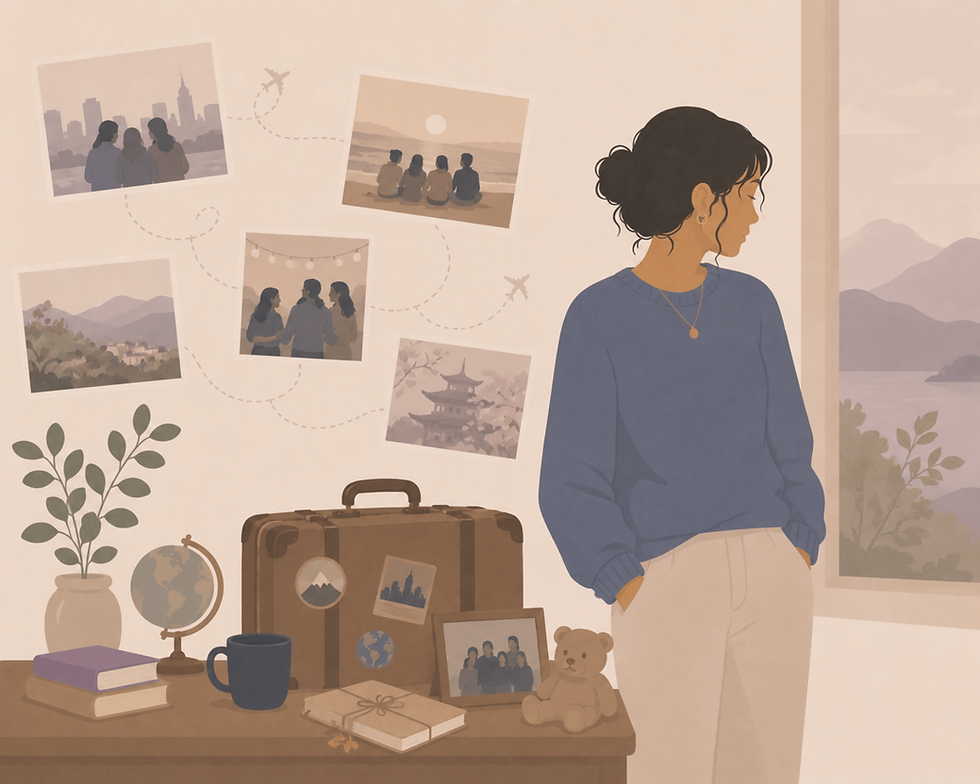
By the time many third culture kids reach adulthood, they have said more goodbyes than most people say in a lifetime. Goodbye to friends, to houses, to schools, to whole countries and to the particular version of themselves that lived in each one. And almost none of that grief was ever actually mourned. In my work I see how heavily it accumulates: each loss was survived, packed up, and left behind, because there was a plane to catch and a new life to start and everyone around you was doing the same thing.
The grief they carry is one of the most overlooked wounds I encounter. It does not look like grief, because it has no funeral, no anniversary, and no name. It looks like restlessness, or a low background sadness, or an inexplicable heaviness that arrives when life finally goes quiet. This post is about that specific grief, the accumulated, unmourned losses of a mobile childhood. For the broader experience of belonging nowhere and the identity questions that come with it, I cover that ground in the larger picture of the adult third culture kid. Here I want to stay with the goodbyes themselves.
Quick Answer: Why Do Third Culture Kids Carry So Much Unresolved Grief?
Third culture kids accumulate loss with every move, friends, homes, languages, and versions of themselves left behind, but rarely get the time or permission to mourn any of it. Because no one recognizes these as real losses, the grief goes unprocessed and surfaces years later as depression, restlessness, or a sorrow with no clear source.
Table of Contents
The Anatomy of a Goodbye You Never Got to Finish
A single move in a globally mobile childhood is not one loss. It is a cascade of them, all happening at once.
In the space of a few weeks you might lose your best friend, your bedroom, your school, your routines, the language you were just becoming fluent in, the climate and food and smells that meant home, and the entire social world in which you knew who you were. Then you arrive somewhere new and have to rebuild all of it from nothing, while still reeling from what you left. And often, the goodbye itself was abrupt and incomplete. You did not get to slowly close out friendships; they ended mid-sentence. You did not get to say a proper farewell to a place; you were simply gone one Tuesday and never went back.
Think about what a single one of those goodbyes actually contained. A best friend you had finally, after months, let yourself trust, whom you would likely never see again and, in those years, never even speak to again. A bedroom that had held every version of you since you arrived. A teacher who understood you, a corner store, a walk home, a whole sensory world that simply stopped existing. To the adults organizing the logistics it was a move. To the child living it, it was the quiet end of an entire life, and it happened again every few years.
The TCK researcher David Pollock described a healthy transition as needing reconciliation, affirmation, farewells, and a focus on what comes next, a way of closing one chapter cleanly before opening another. Most TCK goodbyes had none of that. They were rushed, practical, and emotionally skipped, because the adults were overwhelmed too and there was simply no time. So each move left a trail of unfinished endings, and they accumulated.
Why No One Ever Let You Grieve
Here is the cruelest part. Not only were the losses real and repeated, they were also almost entirely unrecognized, which meant you were never given permission to mourn them.
There is a clinical term for this: disenfranchised grief, a concept developed by Kenneth Doka. It describes grief that is not openly acknowledged, socially validated, or publicly mourned, the kind of loss the world does not count as a real loss. When a grandparent dies, everyone understands that you grieve, and there are rituals to hold it. But when an eleven-year-old loses every friend she has ever known, her home, and her entire world to a transfer overseas, no one holds a service. Instead she hears how lucky she is, what an adventure it will be, how many children would dream of seeing the world the way she gets to. The message, repeated everywhere, is that this is not a loss at all. It is a privilege.
So the grief had nowhere to go. You could not mourn what no one agreed was worth mourning, and you certainly could not complain about a life that looked, from the outside, enviable. On top of that sat the sheer practicality of it: there was no time to fall apart, because you had to start a new school on Monday and make new friends fast or be alone. So you did what the situation required. You shelved the grief and got on with surviving. The problem is that grief does not disappear when it is shelved. It waits.
The Losses That Never Had a Funeral
It can help to name plainly what was actually lost in all those moves, because part of what keeps the grief frozen is that it was never made specific.
You lost friendships, often suddenly and permanently, in an era when staying in touch across continents was far harder than it is now. You lost places that were genuinely home to you, places you can never return to as they were because both they and you have changed. You lost languages, sometimes a whole tongue you were fluent in and then slowly forgot, which carries its own particular grief that I write about in the self you can only be in your mother tongue. And in a quieter way, you lost a series of selves: the child you were in that country, with those friends, in that life, simply ceased to exist when you moved, and a new version had to be assembled somewhere else.
None of these losses came with a ritual, a recognized ending, or anyone to grieve alongside. They were real deaths of a kind, and they were mourned by no one, including, often, you.
Frozen Grief: Why It Is Surfacing Now
A great many adult TCKs come to therapy not understanding why they suddenly feel so much grief for a childhood that ended decades ago. The answer is that the grief was never processed. It was frozen, and it is only now beginning to thaw.
Grief requires safety and stillness to move through the body, and a mobile childhood offered neither. There was always a next move, a next adjustment, a next round of surviving, so the system kept the grief compartmentalized in order to keep functioning. Then, sometimes decades later, life finally stabilizes. You stop moving. You build something that stays. And in that unfamiliar stillness, the vault opens, and the accumulated sorrow of a lifetime of goodbyes begins to surface all at once. This is the same mechanism by which other forms of frozen childhood grief tend to arrive only once a person is finally safe enough to feel them, which I describe in the hidden grief that surfaces when you finally feel safe. It is not regression. It is the grief finally getting its turn.
If you grew up saying goodbye over and over and never once got to truly grieve any of it, and that old, frozen sorrow is surfacing now in ways you cannot quite explain, you are not broken. You are carrying losses that were never allowed to be mourned. I offer EMDR, Brainspotting, and CRM for adults finally grieving the goodbyes of a mobile childhood, across New York and Florida and throughout all PsyPact states. You can request a 15-minute consultation to talk about what it would mean to let yourself mourn.
How Unmourned Grief Shows Up in Adult TCKs
Frozen grief rarely announces itself as grief. It wears other clothes, which is part of why it goes unrecognized for so long.
It often shows up as a low, persistent sadness with no obvious cause, or as a depression that arrives when things are objectively going well. It can look like emotional flatness around goodbyes, a strange inability to feel anything when people leave, because the system learned long ago that feeling the loss was not survivable and shut that channel down.
Or it appears as the opposite: a disproportionate devastation at a small parting, a friend moving away or a lease ending, where the grief of a hundred old goodbyes comes pouring out through one small new one. Some people notice it as a reluctance to fully invest in friendships or places, a self-protective holding back, though that pattern belongs more to the identity and attachment side of the TCK experience that I explore in the broader flagship piece. Here, the point is simpler: a great deal of adult TCK suffering is grief that never got to be grief.
You Are Allowed to Grieve It Now
If there is one thing I want you to take from this, it is permission. You are allowed to grieve these losses, and you are allowed to grieve them now, however long ago they happened.
The disenfranchisement that silenced your grief as a child is not binding on you as an adult. You no longer have to accept the verdict that an enviable childhood cannot also be a grief-filled one, or that losses without funerals are not real losses. Both things were true at once: you may have had genuinely extraordinary experiences, and you may have lost an extraordinary amount in the process. Grieving the losses does not erase the gratitude or insult the adventure. It simply finishes something that was left unfinished, gives an ending to the goodbyes that never got one, and lets a part of you that has been waiting a very long time finally be allowed to feel what it always felt.
It is not too late. Grief does not have an expiration date, and the fact that these losses are decades old does not make them unmournable. It only means they have been waiting.
Sometimes the mourning is quiet and private: letting yourself finally feel the loss of a friend you have not thought about in twenty years, or grieving a country you can never return to as it was. Sometimes it helps to do, late, what you never got to do then, the reconciliation and the proper farewell that the rushed transitions skipped over. You can write the goodbye letter you never wrote. You can name, out loud or on paper, each home and friend and self you lost, and let them matter. None of this brings the lost things back, and it is not meant to. It is meant to give the losses the acknowledgment they were denied at the time, because that acknowledgment is the very thing that lets frozen grief finally move.
How Therapy Helps You Finally Mourn the Goodbyes
The difficulty with grief this old and this frozen is that you usually cannot reach it through talking alone. It was stored below words, in the body and the nervous system, often before you had the language or the safety to process it, so understanding it intellectually rarely thaws it. This is why I work with body-based methods rather than talk alone, an approach I describe in why somatic therapy reaches what just talking cannot.
In practice, I use EMDR, Brainspotting, and the Comprehensive Resource Model to help the frozen grief finally move and complete. We work gently with the accumulated losses so the sorrow that has been held for decades can be felt, mourned, and released, rather than continuing to leak into the present as depression or restlessness.
Because this material can be vast, we build internal safety and resources first and go at a pace your system can hold, which is the gentler, well-resourced approach of the Comprehensive Resource Model, and we establish a felt sense of safety in the body before approaching the grief, which I describe in why your body has to feel safe before any processing can work.
For people whose grief froze into numbness, part of the work is gently restoring the capacity to feel at all, a protective shutdown I describe in what dissociation is and why trauma disconnects you from yourself. You do not need the lost friends, places, or younger selves to be present to mourn them. The grieving happens inside you, and it can finally be completed there. This is part of my therapy for those raised across cultures.
Checklist: Are You Carrying Unmourned TCK Grief?
Read slowly and notice the body's response, not just the mind's. If several of these land, you may be carrying grief that was never allowed to be grief.
You said many goodbyes growing up and cannot remember ever really mourning any of them.
You feel a low, persistent sadness or a depression that arrives even when life is going well.
You feel little or nothing when people leave, as though that channel was shut off long ago.
Or a small parting undoes you far more than it seems like it should.
You were told repeatedly how lucky you were, which made any sadness feel forbidden.
A wave of old grief has surfaced now that your life has finally gone still.
You sense there are losses inside you that were never named, ended, or laid to rest.
Frequently Asked Questions
What is disenfranchised grief?
Disenfranchised grief, a term developed by Kenneth Doka, is grief that is not openly acknowledged, socially validated, or publicly mourned. It is the loss the world does not count as a real loss, so it comes with no rituals, no recognition, and no permission to grieve. For third culture kids, nearly all of their childhood losses were disenfranchised: a child losing her entire world in a move is told how lucky she is rather than offered any acknowledgment that something real was lost. Because the grief was never sanctioned, it had nowhere to go and tends to stay frozen until adulthood.
Why am I grieving moves that happened years or decades ago?
Because that grief was never actually processed at the time. A mobile childhood rarely offered the safety and stillness that grief requires to move through, so the nervous system shelved it in order to keep functioning through the next move and the next. The grief did not vanish; it froze. When your life finally stabilizes in adulthood and you stop moving, the conditions for grieving are present for the first time, and the accumulated sorrow begins to surface. The timing is not random, and it is not regression. It is the grief finally getting the safety it needed all along.
I had an amazing childhood. Am I even allowed to grieve it?
Yes. An extraordinary childhood and a grief-filled one can be the very same childhood. The experiences may have been genuinely enviable, and you may also have lost an enormous amount along the way, friendships, homes, languages, and selves. Gratitude and grief are not in competition, and using how lucky you were to forbid the grief is exactly the disenfranchisement that kept it frozen in the first place. You are allowed to hold both the wonder and the loss at once.
Is it too late to grieve losses from so long ago?
No. Grief has no expiration date. The fact that these losses are decades old does not make them unmournable; it only means they have been waiting. Frozen grief remains workable for as long as it is held, and many people are able to finally mourn childhood losses in their thirties, forties, and well beyond, with real relief. The grief is not less valid for being old, and processing it now can lift a weight you may not have realized you were carrying.
Why do I feel nothing at goodbyes, or fall apart at small ones?
Both are signatures of unmourned grief. Feeling nothing usually means the system learned, early and repeatedly, that feeling the loss of a goodbye was not survivable, so it shut that channel down to protect you. Falling apart at a small parting usually means the new loss has cracked open the reservoir of all the old ones, and the grief of a hundred unmourned goodbyes pours out through the one in front of you. Neither reaction is an overreaction or a malfunction. Both make complete sense once you understand the frozen grief underneath them.
How is TCK grief different from ordinary homesickness?
Ordinary homesickness is the longing for a specific home you can usually return to. TCK grief is more complicated and more layered. It is the accumulated, unmourned loss of many homes, friendships, languages, and selves, often with no single home to return to at all, and it was disenfranchised, never recognized as real loss. Homesickness tends to ease when you go home. TCK grief does not have a home to go to, which is part of why it needs to be actively mourned rather than simply waited out.
Can therapy really help with grief this old?
Yes, and old, frozen grief is very much within reach of trauma-focused, body-based therapy. Because the grief was stored below words and never processed, talking about it often is not enough to move it, but somatic approaches like EMDR, Brainspotting, and CRM work directly with where the grief is held, in the body and nervous system. The aim is to let the frozen sorrow finally thaw, move, and complete, at a pace your system can tolerate, so that it stops surfacing as depression or restlessness and is allowed, at last, to become grief that ends.
The Goodbyes Are Still Waiting to Be Finished
If you grew up between worlds, you learned to leave well: to pack quickly, adapt fast, and not look back too long. What you were rarely given was the chance to grieve any of it. The goodbyes you never got to finish are still waiting to be finished, and the losses no one let you mourn are still inside you, patient, unnamed, and real.
It is not too late to mourn what you lost, and grieving it now is not weakness or self-pity. It is the closure no one ever gave you, finally given to yourself. I work with adults across New York and Florida, and from my office in Gulf Breeze, who are carrying a lifetime of unmourned goodbyes. My therapy for those raised across cultures is built to help you finally lay these losses to rest, gently and at your pace. You can see the areas I serve or request a 15-minute consultation.
The goodbyes waited. Now they get their ending.
Explore More
Dr. Maria Niitepold, PsyD
EMDRIA-Trained Trauma & Somatic Therapist
Serving High-Achievers Across New York and Florida
(850) 696-7218. Call or text anytime.
Healing doesn't have to be hard. It just has to start.
(Disclaimer: This blog post is for educational purposes and does not constitute medical advice, a diagnosis, or a formal doctor-patient relationship. If you are experiencing a mental health crisis, please contact your local emergency services or call 988.)


Comments